
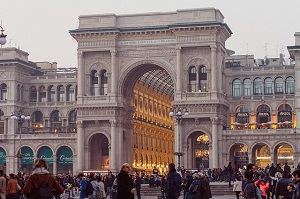
[1] Sir Henry Wotton says building something well must meet three conditions, “commodity, firmness, and delight.” The Galleria Vittorio Emanuele II in Milan, Italy is a perfect example of a building with a specific function, structural integrity, and a pleasing environment for all who enter.

http://www.carhirex.com/sites/carhirex.com/files/content/Galleria_Vittorio_Emanuele_II.jpg
Shopping in one of the greatest cities in the world needs to be a grand experience. Incorporating an enormous steel and glass dome as the focal point shows how important the function of this building is. No expense or architectural and engineering expertise were spared in the design and building of this galleria. Even if someone does not buy anything, the experience of being in such a beautiful, light filled space is delightful.
[2] Chinese design characteristics influenced the fabric below by using naturalistic motifs such as peonies. It also includes traditional Chinese ornament in the other flowers repeated in the design.The laws of the five elements, Yin and Yang, and Feng Shui affect the choice of bold colors, the spacing of the peonies in the patter, and the curvilinear forms in the background.

http://allfreed.ru/uploads/posts/1111/13071208612479_495009.jpg
[3] The lecture hall in the Ferguson Building where we gather for History of Architecture & Theory was built in the 1970s and is typical of that time. There is a lot of dark red and the ceilings are low which make it feel dark and cramped even though it is a large room. The rows are narrow and the seats are small. It is very different than the lecture halls in the newer buildings on campus that were built in the last five years. They have white walls, high ceilings, and windows. The attitude towards personal and social space has changed over the years in the US. Newer designs incorporate larger spaces, lots of windows, and more room for people to move around. In the 1970s, houses, cars, and people were smaller and the need for large open spaces wasn’t there. Even in 2010 in some cultures, this lecture hall would not feel so outdated. The need for more space is not a driving force in many countries not only in architecture but also in how people interact with each other. They stand closer and touch while talking, they live in smaller houses and their favorite car isn’t a SUV. I don’t need a big house or car, but I do like my personal space and our lecture hall is outdated for me since I seem to touch whoever I sit next to at least once each class.
[4] Can there be an Architecture of Happiness? I think that everything changes in time and therefore the beauty and happiness that are found in people and things at one moment will eventually fade. That is not to say it doesn’t change into some other form that promotes happiness, but we have to be open minded to see the change as positive. Alain de Bottom says “Architecture is perplexing, too, in how inconsistent is its capacity to generate the happiness on which its claim to our attention is founded.” A new building is grand and people who enter it feel happy and excited to be in the space. As it ages, only some will look at the cracks and old floors and appreciate the story of the building and still feel happy in it. The others will want to cover up the cracks or demolish it for a newer space thinking that will make them happy to see perfection again. We have to remember that nothing lasts forever and welcome the change. Otherwise we will be chasing a false happiness.

http://www.studentmarket.com/Cooper-Classics-4537-CO1666.html
I think this Starburst mirror exudes happiness because it represents the sun which helps people feel happy. The sun warms us and is needed for everything to grow.


2 comments:
[1] nicely chosen example. well worded. [2] succinct but complete textile analysis. [3] great essay on 100 ferguson. [4] great quote...and quite an eyecatching mirror. sun analogy seems VERY appropriate this week.
katherine --
please turn off the approval function in this comments section of your blog.
--patrick
Post a Comment