Wednesday, September 15, 2010

History - Reading Comp 2

[1]Originally sacrifices took place out in nature and not in temples. These sacred places were surrounded by trees and would inspire the design for columns, which are symbolic in Greek architecture. Sacrifice rituals were documented on the motifs around the temple and the process of the sacrifice was precise and can be seen in the balance and proportion in Greek architecture. Columns were stacked just as the bones, skin, etc were arranged on the offering table. Deconstruction was part of the sacrifice to let the spirit of the god out, and then reconstruction was almost covering up the act of the sacrifice. The remains were holy and needed to be honored, and the proportion of columns show that meaning.

[2]When evidence is mis-interpreted the level of respect and trust for the source declines. Interpretation is insight into the knowledge and experience the source has as well as the time they put in to incorporating additional information from the world to help them in their interpretation. Even if I only know a little about a subject, when I am researching it on the Internet it is clear how much incorrect information is out there. I have to be careful about the subjects that are new to me since I will not always know if I am reading something incorrect. Academic websites and journals are the best place to look for information.

[3]Hatshepsut and the Pyramids speak different design language because one was for a female ruler and the other for male pharaohs. Queen Hatshepsut’s temple was horizontal and fit into the landscape, which related to how she fit in and stretched between empires and brought them together. This is a unique quality of females to unite people and be the backbone and keeps things calm. The form of the pyramids is clearly male. The scale of them is large and stands out from the landscape. Male pharaohs were strong and controlled their empire.

Wednesday, September 8, 2010

point: theories

The main theme in Unit 1-Theories, is to begin to understand architecture inside and out. It is all around us and is considered the Unavoidable Art. Since it comes from the mind, Louis Kahn said, “Architecture is what nature can’t make.” The most obvious reason architecture is unavoidable is because we can’t walk through it. We live in homes, work in offices, attend schools, and worship in places that have been designed for our use. Nicholas Pevsner said, “a bicycle shed is a building, Lincoln Cathedral is a piece of architecture.” The shed is storage for objects, while the cathedral is for people to use. Humans have a lot of interpretations of it and we can see history alive in architecture. It seems complicated since we can learn so much about humanity through it. Architecture shows us about our values, successes and failures, aspirations, physical and social needs, cross-cultural insights, attitudes towards nature, and techniques available at a certain time in history. It is important though to remember the way Vitruvius saw it, stay balanced and keep it simple. Architecture and design is symbolic because it forms a dialogue with the past and future and designers need to know the history and theory of it so we can be conscious of what will be left behind. Designers want their work to be enjoyed for a long time, so it needs to be built well. Sir Henry Wotton said, “Well building hath three conditions: commodity, firmness, and delight.” If the function of the building meets the needs of people, the structure is strong, and it remains a pleasing experience for people, it will be a success.

In this unit we discussed all aspects of design, not just architecture. We talked about material culture and how people process the meaning of objects and we heard the ideas from three theorists that explain it very well. Jules David Prown believes that description, deduction, and speculation are a three-step process we use to form an opinion of an object. A silver tea pot from the 1800s was used as the example. To the owners, it was a comforting object that served warm tea. To the slaves, it was a sign of oppression. Dick Hebdige wrote more about the meaning behind an object using double meaning, maps of meaning, and subculture. And finally, Roland Barthes theorized about the hidden rules, codes, and conventions of meanings through semiotics, ideologies, and signs.

We discussed the design cycle theory that says we start with creativity in early life, we are at the height of creativity in mid life, and then creativity declines at the end of life. Learning the cycle of design is important for various reasons. We can appreciate the youth and observe the way they create things and incorporate their open mindedness into our designs. Then value the current moment and jump into our designs with both feet, knowing that our level of excitement and creativity will not always be the same. And finally, accept we will not be young forever so we need to design for the next generation, to inspire them and tell our story.

http://affair-jupiterhotel.com/wp-content/uploads/2010/04/Design_History_Understanding_Theory_and_Method-2514.jpg

I chose the image above to describe the theories unit because we discussed the past, present, and future. The gray blocks represent the past and future and the colored blocks represent the present. We have to design and build with careful consideration of the past and future, however the present is the most important time for us as designers.

Tuesday, September 7, 2010

Face The Wall

A wall is never "just a wall." Our first studio project is to design a free standing wall to be installed somewhere on campus. This is my design and it is not only a wall but also an interactive structure. The scale is 1"=1'-0" which makes the actual length 28' and the tallest post 8' high.
Its hard to see in the picture below, but I changed the placement of the posts in my second design so they had a pattern instead of being randomly placed.

Monday, September 6, 2010

History In My Back Yard

Some good friends from Maryland visited me this weekend and we went to see Duke University. WOW...I cant believe how beautiful the chapel is. I felt like I was in Europe!


Wednesday, September 1, 2010

History - Reading Comp 1

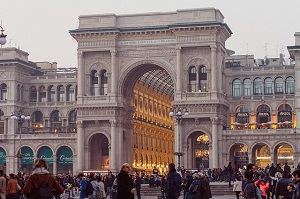
[1] Sir Henry Wotton says building something well must meet three conditions, “commodity, firmness, and delight.” The Galleria Vittorio Emanuele II in Milan, Italy is a perfect example of a building with a specific function, structural integrity, and a pleasing environment for all who enter.


http://www.carhirex.com/sites/carhirex.com/files/content/Galleria_Vittorio_Emanuele_II.jpg

Shopping in one of the greatest cities in the world needs to be a grand experience. Incorporating an enormous steel and glass dome as the focal point shows how important the function of this building is. No expense or architectural and engineering expertise were spared in the design and building of this galleria. Even if someone does not buy anything, the experience of being in such a beautiful, light filled space is delightful.

[2] Chinese design characteristics influenced the fabric below by using naturalistic motifs such as peonies. It also includes traditional Chinese ornament in the other flowers repeated in the design.The laws of the five elements, Yin and Yang, and Feng Shui affect the choice of bold colors, the spacing of the peonies in the patter, and the curvilinear forms in the background.


http://allfreed.ru/uploads/posts/1111/13071208612479_495009.jpg

[3] The lecture hall in the Ferguson Building where we gather for History of Architecture & Theory was built in the 1970s and is typical of that time. There is a lot of dark red and the ceilings are low which make it feel dark and cramped even though it is a large room. The rows are narrow and the seats are small. It is very different than the lecture halls in the newer buildings on campus that were built in the last five years. They have white walls, high ceilings, and windows. The attitude towards personal and social space has changed over the years in the US. Newer designs incorporate larger spaces, lots of windows, and more room for people to move around. In the 1970s, houses, cars, and people were smaller and the need for large open spaces wasn’t there. Even in 2010 in some cultures, this lecture hall would not feel so outdated. The need for more space is not a driving force in many countries not only in architecture but also in how people interact with each other. They stand closer and touch while talking, they live in smaller houses and their favorite car isn’t a SUV. I don’t need a big house or car, but I do like my personal space and our lecture hall is outdated for me since I seem to touch whoever I sit next to at least once each class.

[4] Can there be an Architecture of Happiness? I think that everything changes in time and therefore the beauty and happiness that are found in people and things at one moment will eventually fade. That is not to say it doesn’t change into some other form that promotes happiness, but we have to be open minded to see the change as positive. Alain de Bottom says “Architecture is perplexing, too, in how inconsistent is its capacity to generate the happiness on which its claim to our attention is founded.” A new building is grand and people who enter it feel happy and excited to be in the space. As it ages, only some will look at the cracks and old floors and appreciate the story of the building and still feel happy in it. The others will want to cover up the cracks or demolish it for a newer space thinking that will make them happy to see perfection again. We have to remember that nothing lasts forever and welcome the change. Otherwise we will be chasing a false happiness.


http://www.studentmarket.com/Cooper-Classics-4537-CO1666.html

I think this Starburst mirror exudes happiness because it represents the sun which helps people feel happy. The sun warms us and is needed for everything to grow.